Anthropic’s Major Improvement in User Rate Limits
On May 6, Anthropic announced a significant enhancement to its user rate limits by partnering with SpaceX. Under the agreement, Anthropic will utilize the full computing power of SpaceX’s Colossus 1 facility in Memphis, Tennessee, which houses over 220,000 Nvidia GPUs. This will provide Anthropic with an additional 300 megawatts of capacity within a month, directly improving the service capabilities available to Claude Pro and Claude Max subscribers.
With the additional capacity from the SpaceX deal and other similar agreements, Anthropic stated that it will double the five-hour rate limit for Claude Code in the Pro, Max, Team, and Enterprise plans billed per seat. It will also lift the peak hour quota reduction limits for Claude Code on Pro and Max accounts and significantly increase the API rate limits for the Claude Opus model.
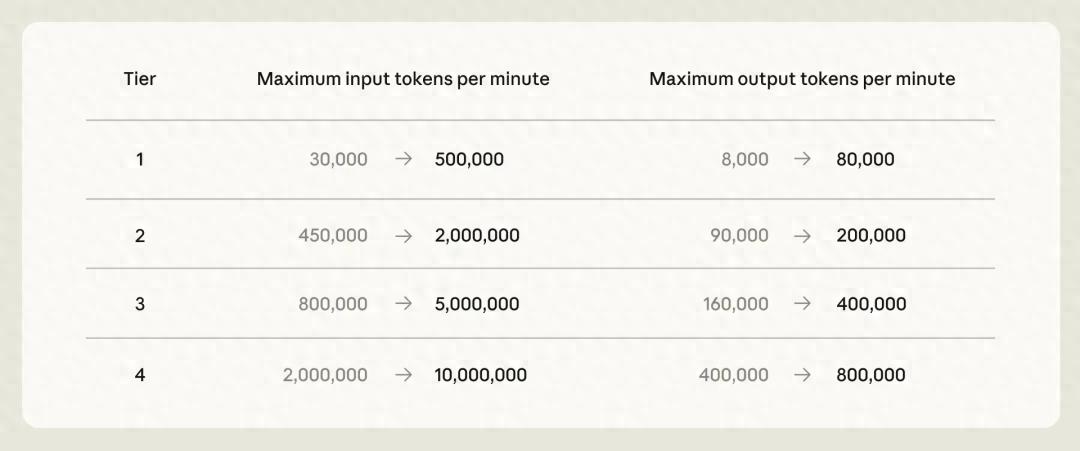
The official announcement noted that API transaction volume on the Anthropic platform has increased 17 times year-over-year.
Tom Brown, co-founder and CCO of Anthropic, tweeted that the company will gradually enhance Claude’s reasoning capabilities on Colossus over the coming days. He expressed excitement about collaborating with SpaceX, stating, “To keep up with AI demand, we need to mobilize a lot of real-world ‘atoms’, and no one is better at rapidly mobilizing atoms, whether on Earth or off, than they are.”

Anthropic has also expressed interest in collaborating with SpaceX to develop multiple gigawatt-scale (GW) space-based data centers, which is one of Musk’s key goals and a significant driver behind SpaceX’s upcoming IPO, as this project is expected to rely heavily on capital investment and face considerable technical challenges.
Ryan Mallory, CEO of data center operator Flexential, commented, “Serious companies have even begun discussing computing capacity in space, which itself indicates how aggressively the market is seeking power and scaling.”
In an interview with CNBC, Boris Cherny, head of Claude Code, stated, “Our growth has been explosive, exceeding all our forecasts. At Anthropic, we place great importance on responsibly managing capacity and the resources we rely on to build everything. Responsibility is not just a slogan for us; it’s how we view our work. Therefore, when customers have a certain demand, we need corresponding computing power to meet those needs. Now that demand has exploded, we have onboarded more capacity, and more will come online to keep up with demand.”
Boris indicated that in terms of internal capacity allocation, there will be a balance between product and research needs in the long run. “That’s the overall balance. The most important thing is that this balance must be very healthy in the long term. We cannot buy a lot of unused capacity, nor can we buy too little. So the core is to maintain balance and keep it healthy.”
Today, Nvidia also congratulated Anthropic, stating, “The future of AI depends on NVIDIA.”
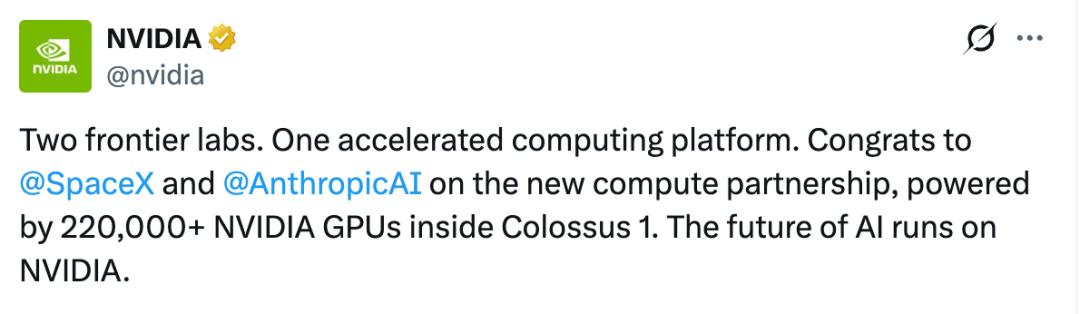
Additionally, this collaboration adds to a series of significant capacity advancements previously announced by Anthropic:
- An agreement with Amazon for up to 5 gigawatts, including nearly 1 gigawatt of new capacity by the end of 2026;
- An agreement with Google and Broadcom for 5 gigawatts of capacity, which will gradually come online starting in 2027;
- A strategic partnership with Microsoft and NVIDIA, including $30 billion in Azure capacity;
- An investment of $50 billion in U.S. AI infrastructure through Fluidstack.
“We train and run Claude on various AI hardware, including AWS Trainium, Google TPU, and NVIDIA GPUs, and will continue to explore opportunities to bring more capacity online,” Anthropic stated.
Alex Finn, founder and CEO of Henry Intelligent Machines PBC and Buddy, remarked, “This is crazy.” He noted that Anthropic had been struggling in recent months, with usage limits being continuously lowered, Claude Code being removed from the Pro plan, and the model feeling less capable. “Elon essentially rescued them this time, granting them access to the world’s largest supercomputing cluster. Anthropic’s capacity shortage has always been the Achilles’ heel of the entire company, leading to a significant decline in user reputation. Elon solved this problem with one deal.”
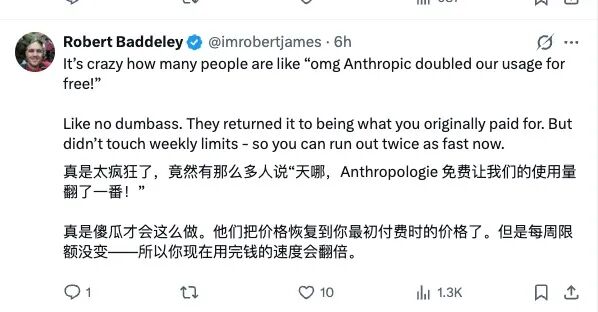
Finn expressed hope that this means the long period of silently lowering limits and poor communication from Anthropic is finally over, stating, “At its peak, Claude Code was truly legendary.” However, some users pointed out that this increase in limits merely returns to levels from three months ago.

SpaceX Gains a Major Client
This deal clearly brings a heavyweight client to SpaceX, which is preparing for an IPO, helping it showcase its AI ambitions to investors. Musk also briefly discussed the collaboration on X, stating, “Last week, I spent a lot of time talking with senior members of the Anthropic team to understand what they are doing to ensure Claude is beneficial to humanity. After our discussions, I was impressed. Everyone I met was very capable and genuinely concerned about doing the right thing. No one triggered my ’evil detector.’ As long as they continue rigorous self-examination, Claude is likely to be good. After that, I agreed to lease Colossus 1 to Anthropic, as SpaceXAI had already migrated training to Colossus 2.”
This stands in stark contrast to Musk’s comments from February, where he criticized Anthropic’s AI for bias, stating, “Frankly, I think no matter what you do, you can’t escape the inevitable irony: Anthropic will ultimately become anti-human.”
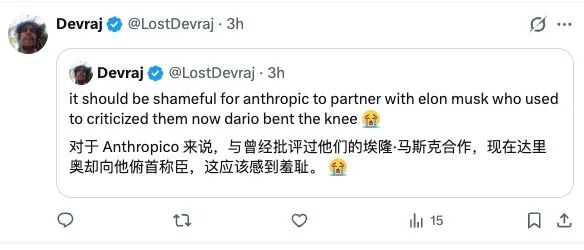
Clearly, people have not forgotten Musk’s earlier remarks:

A user commented, “This move is indeed clever for SpaceX. They turned an asset originally built for a bottomless pit (Grok) into a significant revenue source ahead of the IPO.” However, some users viewed this as “shameful” for Anthropic.
One user remarked, “In my view, this merger is clearly intended to quietly shut down xAI while keeping investors satisfied. Additionally, it is being used to offload Twitter’s debt onto the public; it seems his accounting team is indeed very skilled.” In fact, Musk announced almost simultaneously that xAI would no longer exist as an independent company and would be integrated into SpaceXAI, the AI product line under SpaceX.
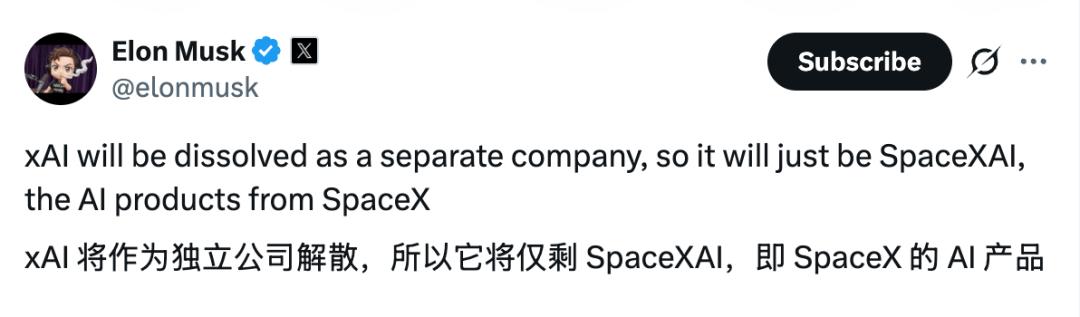
“As long as the outside world realizes that xAI is evidently turning into a data center company rather than an AI company before this is completed, it will still be an asset for SpaceX to raise its IPO valuation,” a user commented.

For this collaboration, Jamin Ball roughly calculated the financials for Musk:
Assuming Colossus 1 has 220,000 GPUs, including 150,000 H100s, 50,000 H200s, and 20,000 GB200s, with pricing at $2.30 per hour for H100, $2.60 per hour for H200, and $5 per hour for GB200, the blended leasing price for the entire cluster is $2.60 per hour.
Assuming these are all take-or-pay type transactions, meaning you pay for 24 hours × 365 days regardless of actual usage, this implies that xAI could generate approximately $5 billion in annual revenue.
We have a new neo cloud!
Additionally, Jamin Ball referenced some rough calculations made by Dario in a recent episode of the Dwarkesh podcast regarding unit economic models. Dario suggested that there could be $100 billion in computing power expenditures, which would undergo structural allocation between training and inference: if too biased towards training, it would not generate enough revenue; if too biased towards inference, it would weaken future R&D progress. Assuming a 50-50 split in computing power expenditures, inference operations could support $150 billion in revenue, with a gross margin above 50%.
Jamin Ball applied this logic to the xAI transaction, concluding that Anthropic could convert this computing power into $15 billion in annual revenue, corresponding to a gross margin of 60% to 70%. “A win-win!!” he concluded.
Gary Marcus, a scholar at NYU, expressed the view that leasing 30 megawatts of computing power to Anthropic indirectly acknowledges that xAI is not as close to AGI as Musk had previously suggested. Furthermore, it proves that merely scaling up does not lead to AGI.
Marcus also pointed out that if xAI ultimately becomes just another cloud computing company in an increasingly crowded market, SpaceX’s investors may have overpaid.
“The fact that xAI has enough surplus computing power to sell to a major competitor is not a good sign for ultra-large cloud vendors. We may soon enter a world where supply exceeds demand, leading to a sharp drop in prices. Clients will be the winners, but companies like Amazon, Google, Meta, Microsoft, and Oracle could be significantly impacted, especially considering the pressure they have already faced on their cash flows to build cloud computing resources.”
Anthropic’s Push for Enterprise Clients
On Wednesday, Anthropic held a developer day event in San Francisco and announced a new feature for Claude AI called “dreaming.” This feature aims to help the AI system learn by reviewing work across different sessions, identifying patterns, and updating files used to store user preferences and other contextual information. The “dreaming” feature is currently available as a research preview and was launched alongside its software for managing intelligent agents.
This move is part of Anthropic’s efforts to compete for enterprise clients. Previously, Claude Code’s popularity surged, intensifying market competition and prompting OpenAI to scale back some initiatives, such as its Sora video generation tool, to focus more on the rapidly growing AI programming market.
During the event, Boris demonstrated how developers could set up “routines” to have Anthropic’s AI computer programmer perform tasks as scheduled. He stated, “The default state is no longer, ‘I will prompt Claude Code.’ The new default state is, ‘I will let Claude prompt Claude Code.’”
Cherny emphasized the productivity potential of AI, saying, “The capability is already here. The remaining gap is how quickly we can deploy it.”
In an interview, Boris also mentioned that for enterprises to truly realize productivity gains from AI, they cannot treat AI merely as an add-on tool but must restructure their business processes around AI.
He cited early cases of computer productivity: when computers first emerged, businesses did not see immediate efficiency gains because their processes were still centered around old filing cabinets and manual workflows, with computers merely placed in corners. Only when businesses placed computers at the center of workflows did the productivity dividends truly materialize.
Boris believes AI is facing a similar phase today. For Anthropic, Claude is already at the center of all company operations, while the most mature enterprise clients are restructuring their business processes around Claude. This enhancement is not just a few percentage points but several times the productivity increase, and the pace of enhancement continues to accelerate.
Regarding AI’s impact on the software industry, Boris acknowledged that some traditional moats are disappearing, especially switching costs. Because Claude can help users write software and facilitate easier migration from one software to another. However, he does not believe all old moats will be destroyed. Instead, many traditional moats remain effective; everything is just accelerating, and the pace of competition is becoming faster.
When asked if Anthropic aims to become the “front door” for future applications and customer relationships, Boris stated that the company will consider multiple angles. On one hand, Anthropic does hope to directly own customer relationships for certain products; on the other hand, it also wants to remain open and fair.
He emphasized that the tool stack used by Anthropic is also open to developers. For example, Claude Code is built on top of the Claude Agent SDK and Anthropic API, and these capabilities are available to developers worldwide. Anthropic has already seen many developers building businesses and startups based on the same technology stack.
In Boris’s view, software capabilities will become foundational skills in modern society, akin to literacy. Ordinary people will be able to generate software by conversing with Claude, just as everyone can write today. However, this does not mean that professional developers will disappear. Boris likened it to writing: while everyone can write, society still needs professional writers. Similarly, in the future, everyone will be able to use AI to write code, but there will still be a need for people with specialized expertise in software development.
He also emphasized that whether engineers, product managers, or designers, companies will still need the best talent. AI will change how work is done but will not diminish the value of top talent. Instead, in an environment where all tools are stronger and all rhythms are faster, those who can truly understand problems, define directions, and build products will remain very scarce.
Additionally, for young people about to graduate or still in college, Boris offered two pieces of advice:
- Learn to use these tools. Do not fear AI or intelligent agents. You should actively approach them, try them out, and understand how they fit into your work style.
- If you have an entrepreneurial spirit, now is the best time to start a business. Boris believes AI is ushering in a golden age of innovation. A lot of innovation is already happening today, and even more changes will emerge. He even predicts that the number of startups in the future could be tenfold or even a hundredfold compared to today.
Comments
Discussion is powered by Giscus (GitHub Discussions). Add
repo,repoID,category, andcategoryIDunder[params.comments.giscus]inhugo.tomlusing the values from the Giscus setup tool.