Anthropic’s New Model Claude Mythos Surpasses Opus with Generational Leap
On March 26, Fortune reported that due to an internal configuration error at Anthropic, details of their most confidential technology were inadvertently disclosed. The new flagship model, named “Claude Mythos” and internally codenamed “Capybara,” has completed training and entered early testing. Its performance has been described as a “generational leap,” significantly surpassing the current strongest version, Claude Opus 4.6, in programming, academic reasoning, and cybersecurity tests.
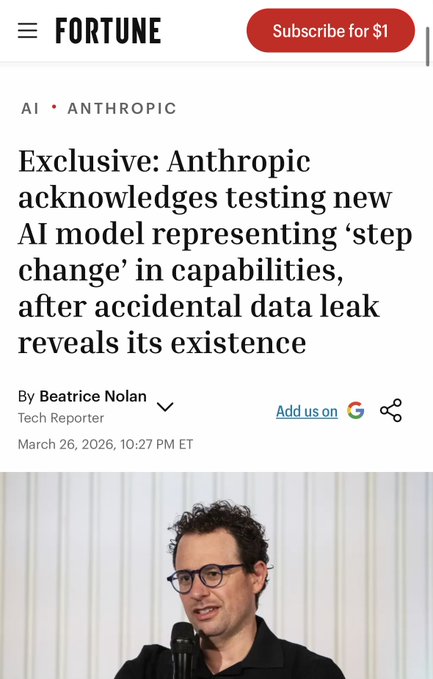
The leak occurred due to a human error in Anthropic’s content management system (CMS), which exposed nearly 3,000 unpublished internal documents in a publicly accessible data cache. These documents revealed the company’s plan to introduce a new model tier, “Capybara,” positioned above the existing flagship Opus series, with higher operational costs.
However, this enhanced performance comes with unprecedented security concerns. The leaked internal drafts indicate that Anthropic considers the new model a significant risk in cybersecurity, believing its capabilities for cyber attacks “far exceed any current AI model.” If exploited by hackers, it could lead to large-scale cyber attacks with destructive power surpassing defenders’ capabilities—this is a core reason the company has hesitated to publicly release it.
Beyond Opus: The New “Capybara” Tier Breaks Existing Patterns
The leaked blog drafts suggest that Claude Mythos represents a structural reorganization of Anthropic’s product line. Currently, Anthropic’s model matrix consists of three tiers: the most capable Opus, the balanced Sonnet, and the smallest and fastest Haiku. The leaked documents indicate that Anthropic is introducing a new “Capybara” tier, positioned above Opus—larger in scale, higher in intelligence, but also more expensive to operate.
In terms of specific performance, the drafts state that “Capybara has significantly improved scores in software programming, academic reasoning, and cybersecurity tests compared to the previous strongest version, Claude Opus 4.6.” The document describes Claude Mythos as “the most powerful AI model we have developed to date, far surpassing any previous version.”
An Anthropic spokesperson confirmed this direction in response to Fortune’s inquiry, stating the company is “developing a general model that achieves significant advancements in reasoning, programming, and cybersecurity” and emphasized that “due to its powerful capabilities, we are cautiously advancing the release strategy.”
Unprecedented Cybersecurity Risks: Anthropic’s Own Vigilance
Accompanying its powerful capabilities are strong security warnings in the leaked documents. The drafts explicitly state that the new model “currently far exceeds any other AI model in its cyber attack capabilities” and predicts “an upcoming wave of models whose vulnerabilities will far exceed the defenders’ ability to respond.”
Due to this concern, Anthropic has prioritized cybersecurity defense agencies in its release strategy. The drafts indicate, “We will first grant early access to relevant agencies, allowing them to strengthen their codebase resilience ahead of the impending AI-driven wave of exploitations.”
This concern is not isolated. In February, OpenAI released GPT-5.3-Codex, the first model rated as having “high capability” in cybersecurity tasks and specifically trained to identify software vulnerabilities. Concurrently, Anthropic’s Claude Opus 4.6 also demonstrated the ability to identify unknown vulnerabilities in production codebases, a characteristic the company acknowledges as a dual-use “double-edged sword.”
Configuration Error: 3,000 Internal Files Accidentally Made Public
The technical root of this leak lies in a seemingly minor operational error. Roy Paz, a senior AI security researcher at LayerX Security, and Alexandre Pauwels, a cybersecurity researcher at Cambridge University, discovered that the external CMS tool used by Anthropic for publishing official blogs had a configuration flaw: the system defaults to making uploaded digital assets public and assigns accessible URLs unless users manually set them to private. This default setting led to nearly 3,000 unpublished assets—including images, PDF files, and audio files—being exposed in a publicly searchable data cache.
Anthropic attributed the incident to “human error,” stating that “a problem with the external CMS tool caused draft content to be publicly accessible” and characterized the leaked materials as “early drafts considered for publication.”
X Platform Erupts: Shock and Doubt Coexist
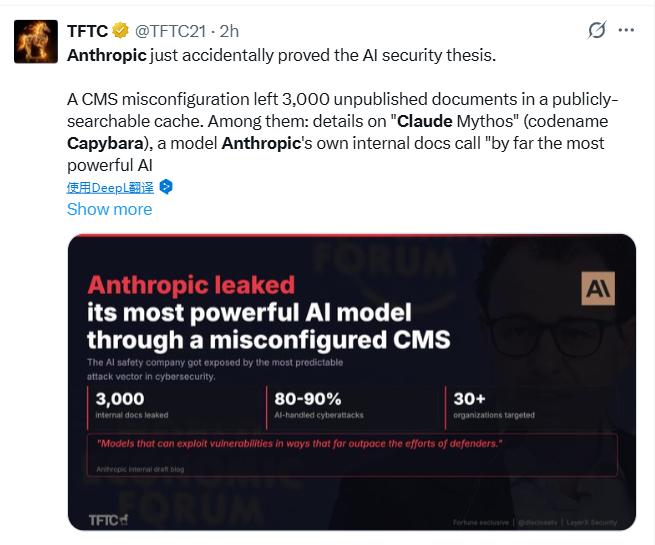
Once the news broke, the X platform was quickly abuzz with discussions, focusing on both the technological shock and security trust dimensions. The account TFTC pointed out the irony of the incident, stating, “Anthropic inadvertently proved the AI safety argument. A CMS configuration error led to 3,000 unpublished documents being exposed in a publicly searchable cache—among them details about ‘Claude Mythos’ (codenamed Capybara), which internal documents call ’the most powerful AI to date.’” This comment spread widely in the tech community, with many users expressing shock that a company centered on AI safety could expose its secrets due to a basic configuration error.
Another user, fardeen, shifted focus to Claude’s latest capabilities, commenting, “Claude can now really use a computer like you—open applications, click buttons, fill out forms. Anthropic is gradually removing humans from the operational process.”

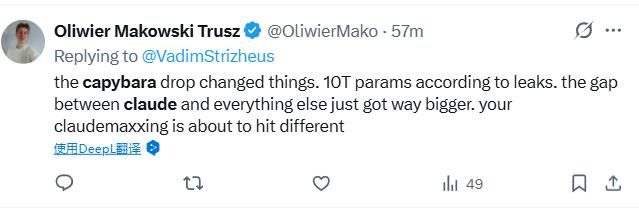
User Oliwier Makowski Trusz believes the release of Capybara changes the landscape. According to the leaked information, the parameter count reaches 10 trillion, significantly widening the gap between Claude and all other models.
Comments
Discussion is powered by Giscus (GitHub Discussions). Add
repo,repoID,category, andcategoryIDunder[params.comments.giscus]inhugo.tomlusing the values from the Giscus setup tool.