
On March 7, in Shanghai, BaiFu woke up in his rented room and habitually opened GitHub. He was stunned to see MiroFish topping the global trends list. This was the result of 10 days of vibe coding, developing a collective intelligence engine aimed at predicting everything.
Two days later, on March 9, he opened GitHub again to find his project BettaFish had also made it into the top ten. One ranked third and the other fifth, with his ID “666ghj” standing out among the English descriptions and IDs.
BaiFu recalled his pet Betta fish, known for its beauty and aggressive nature, which had become famous as the default desktop wallpaper for Windows 7 Beta. “You’re popular again,” he thought.
The AI community was buzzing. Some labeled BaiFu a “genius” for achieving this in just ten days, while others called him a “pioneer of AI programming”. However, BaiFu felt these labels were too casual. He knew who he was: an ordinary senior at a university in Beijing, who had previously struggled with internship anxiety and coding challenges.
The journey from what others deemed an “unqualified graduation project” to receiving a 30 million yuan investment from Chen Tianqiao, and having two projects simultaneously top the charts, took less than six months.
1. 10 Days of Vibe Coding: A Disregarded Graduation Project
Rewind to the summer of 2025. In the last ten days of his junior summer break, BaiFu decided to finish his graduation project early. With his future plans set, he wanted to focus on finding an internship without the pressure of thesis and coding.
He aimed for a complete project on GitHub in ten days, hoping to achieve 1,000 stars. After spending seven to eight days on topic selection, he immersed himself in open-source communities and tech forums, even consulting professionals in public opinion analysis.
He noticed a trend: AI Agents were popular, with many projects focusing on “AI + news”. Most high-rated projects on GitHub were related to this. However, he found that public opinion analysis, which heavily relies on data, was still stuck in traditional data dashboard stages. The so-called “AI+” solutions merely added a small AI assistant to the corner of dashboards. No one was creating a deep, fully automated, multi-agent collaborative public opinion analysis system.
“This is a gap,” BaiFu thought. “No one in the tech circle is doing it, but ordinary people are interested, and students need a new open-source project to learn from.”
He also noticed that searches for “public opinion analysis systems” on Bilibili yielded outdated, repetitive results. “It’s time for something new.”
Thus, BettaFish was born. The name was inspired by his Betta fish—small, aggressive, and beautiful—reflecting the project’s characteristics: compact, fierce, and striking.

During those ten days, he was in an extremely excited state, coding day and night. He used AI programming tools, which he termed vibe coding, to quickly turn his ideas into products. “I’m not a top-notch coder,” he admitted. “I know a bit about everything but not deeply. AI tools filled my gaps.”
After ten days, BettaFish was complete—a multi-agent public opinion analysis system that could automatically gather information, analyze sentiment, and generate reports. However, when he showed it to a PhD senior, it was dismissed as not even a qualified project.
Feeling disheartened but determined, he uploaded the code to GitHub anyway. Soon, BettaFish garnered 1,000 stars. “I thought 1K stars were perfect for a student,” BaiFu said. He celebrated with a post, thinking that was the end.
But things spiraled out of control.
2. The Uncontrollable Surge: Emails He Dared Not Open
The star count for BettaFish skyrocketed beyond BaiFu’s expectations. 1K, 2K, 5K… The numbers surged like a runaway stopwatch, mirroring his emotional rollercoaster.
Along with this, his inbox flooded with hundreds of emails from investors, business collaborations, and HR from major companies, along with various strange invitations.
“At first, I was excited, opening emails and thinking, wow, this person is praising me, I’m recognized,” BaiFu recalled. “But soon it became overwhelming. Each email required a choice: Yes, No, or Maybe.”
He feared making choices—not just because there were too many, but also due to feeling unqualified to decide correctly. Each email challenged his understanding as a pure science student. Terms like financing, valuation, and equity structure felt foreign.
“I eventually stopped opening those emails,” he said, noting he lost ten pounds in the first week, visibly worn out. His state was less about being intoxicated by GitHub success and more about being overwhelmed by the immense potential of AI coding.
That month felt like wandering through fog. Once the initial email frenzy passed, he gradually calmed down, starting to watch “beginner entrepreneurship” tutorials on Bilibili to understand the AI industry and financial markets, slowly bridging his knowledge gaps.
This reaction starkly contrasted with the public’s image of a “genius boy”. There was no pride, no ambition—just a 20-something feeling dazed by sudden attention. “I think this is a normal reaction for an ordinary person,” he reflected. “I’m not a genius; I feel anxious and confused too.”
He even avoided reading tech media articles about himself, fearing sensationalized headlines.
Yet, he remained confident that BettaFish would succeed. “When I created it, I believed it would succeed,” he stated. “I just didn’t expect it to be this successful.”
3. A Chaotic Mutual Pursuit
After BettaFish gained popularity, major companies in China reached out to him—ByteDance, Alibaba, Tencent… offers and collaboration invitations poured in.
It felt surreal. He could stay in Beijing, close to school, with a lucrative job that sounded impressive and would earn him likes on social media.
Ultimately, he chose to join Shengda Group, under Chen Tianqiao’s team. “Mr. Chen’s team told me, if you come here, we’ll support you in doing what you love,” BaiFu recalled.
This was a rational choice. After interacting with many investors and executives, BaiFu sensed a suffocating urgency from them. Although he didn’t voice it, he felt it deeply.
He had initially rejected Shengda’s offer out of habit. However, the Shengda team persisted in communicating with him, emphasizing they wanted to support him in pursuing his interests without expecting immediate results.
This reassurance grounded him during a chaotic time, alleviating his pressure.
In reality, resources like computing power, data, and talent were being absorbed by large companies. The consensus in the industry was that only major players could participate in the AI arms race.
BaiFu wasn’t purely an idealist; his online ID—BaiFu—was a combination of Li Bai and Du Fu, reflecting his desire to balance romanticism with realism.
“After BettaFish became popular, I accepted the reality of the situation,” BaiFu thought. With graduation approaching, he decided to take the plunge and move to Shanghai alone, carrying just a backpack.
An introverted person, he ventured into Shengda without any fanfare or press release.
Shengda provided an environment where he didn’t have to perform; he just needed to create. If there was anything else, it was to create freely and without worries.
4. From Rearview Mirror to Telescope
After BettaFish’s success, BaiFu didn’t stop brainstorming. He had already roughly outlined a “three-step data analysis strategy”: data collection, data analysis, and data prediction.
BettaFish addressed the first two steps. The third step was what he always wanted to pursue.
Upon joining Shengda, he finally had the time and resources, leading to the birth of MiroFish. “BettaFish analyzes the past, like a rearview mirror; MiroFish predicts the future, like a telescope,” he explained.
However, the push to create MiroFish came not just from his ideas but also from user feedback. “Many users found BettaFish’s reports detailed and visually appealing but didn’t know how to utilize them,” BaiFu discovered.
This insight made him realize that many needed not just a “rearview mirror” summarizing the past but a “telescope” to see what might happen in the future. The past is a given; people are more concerned about future possibilities.
He wondered, could the “end of summarization” become the “beginning of prediction”?
BaiFu fed various AI programming tools an unstructured document, hoping they could code a product simulating different roles, perspectives, and actions to generate a predictive report.
This product didn’t need to make long-term predictions; it only needed to provide the “locally optimal solution” under current conditions—like a sci-fi movie where the protagonist anticipates an opponent’s moves and reacts optimally in an instant.
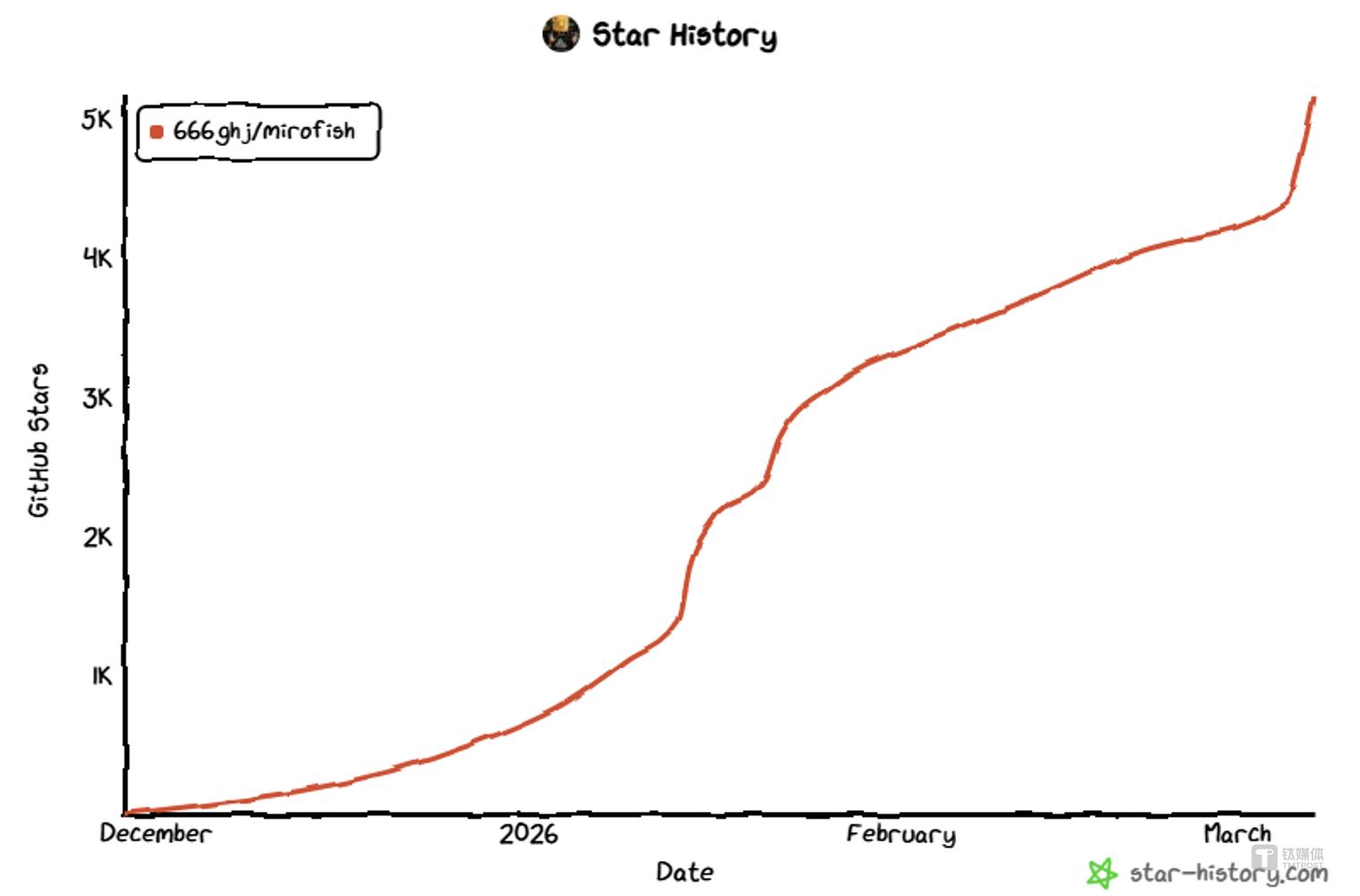
After another ten days of vibe coding, MiroFish emerged and soon topped GitHub again, validating BaiFu’s emerging AI creation methodology: “Good idea + AI tools + rapid implementation = success”.
5. 30 Million: Time to Transition from “Project” to “Career”
A significant turning point in BaiFu’s story came during a meeting with Chen Tianqiao, the founder of Shengda Group. On the day MiroFish was completed, BaiFu sent a rough introduction video to Chen. After watching it, Chen quickly contacted BaiFu for a one-hour video call.
He posed a series of questions about thinking in the AI era:
“How can we enhance collaboration between large models and humans?”
“From a technical standpoint, BettaFish isn’t particularly outstanding. I’m curious about your thought process transitioning from BettaFish to MiroFish.”
“Why did you start with public opinion analysis and envision predicting everything?”
BaiFu felt that Chen wasn’t there to evaluate him; it felt more like two passionate explorers discussing AI on equal footing. This wasn’t a hierarchical assessment but rather a conversation between two seekers.
As the call neared its end, Chen proposed investing 30 million yuan to incubate MiroFish. BaiFu’s initial reaction was excitement—“Finally recognized!” But quickly, pressure set in. He realized this was no longer just a personal project; it was a serious undertaking he had to embrace.
“I had to quickly switch my pace, responsibilities, and career,” he felt nervous yet accepted the offer. Not because he wanted to be a “genius young entrepreneur” but because Chen provided a platform for him to pursue his passions, and he had a stage to give back.
Outwardly, this seemed like another “young genius picked by a big shot” narrative. In response to the investment, Chen stated that supporting MiroFish wasn’t about adding another AI tool to the market but aligning with his vision of transitioning AI from merely “answering questions” to genuinely “solving problems”.
“The core logic of this investment is ‘investing in people’.” Chen emphasized that the path to AGI doesn’t require short bursts of effort but a system that nurtures strong individuals and continuously expands capability boundaries.
The birth of MiroFish revealed a rare quality: young entrepreneurs can not only define real problems but also leverage AI for rapid iteration and solidify ideas into usable products.
The former youngest billionaire in China remarked:
“Our role isn’t to guide them in coding but to provide patient capital, computational support, and organizational assurance. We want to amplify, protect, and continuously motivate ‘super individuals’ in an AI-native environment, ensuring their creations receive timely rewards.
“For me, witnessing and supporting the growth of such individuals transcends the investment itself. As I’ve often said, in this new AI era, I view the success of these young AI talents as the most critical marker of my personal success.”
6. The “Idea King” and One of the First to See the “Entry Point”
BaiFu’s alias embodies a youthful aspiration. “Li Bai represents strong imagination and vitality, while Du Fu embodies observation and responsibility. Combining them serves as a reminder: in technology and product development, one must pursue dazzling creativity while maintaining an understanding of the real world.”
Throughout his life, BaiFu never considered himself different from others. Like many peers, he experienced specific anxieties at each stage of growth.
“In school, we were encouraged to minimize individual differences and strive for the same goals. I was just another student, gradually improving through practice, aiming to get into a good university,” BaiFu shared, summarizing his growth journey.
When did he realize he was a bit different? Perhaps it was when he was known as the “Idea King” among friends, driven more by a passion for creation than for studying.
His favorite game was “Minecraft”. When he got really into it, he would spend an entire night building a house with bricks. If no one saw it, it didn’t matter; he could admire it himself countless times, thinking, “How creative!”
He was fascinated by creative games. Later, when he became interested in programming, he chose computer science because he saw others create beautiful websites with code, akin to building houses in “Minecraft”.
He fell into frontend development, thinking it was “cool”. Later, realizing frontend alone wasn’t enough, he learned backend, machine learning, and agent development, gradually illuminating his “skill tree”.
His Bilibili favorites list is filled with hundreds of online courses, “I watch what I need.”
“I don’t learn each course directly; I learn based on needs. For instance, if I want to build a complete website but only know frontend, I’ll learn backend. It’s like leveling up my skills in a game, which is thrilling.”
He defines himself as someone who learns by doing and does while learning. This “demand-driven” approach has made him a jack-of-all-trades—knowing a bit about everything but mastering nothing.
In traditional evaluation systems, this might be seen as a shortcoming. “While others study papers to understand underlying principles, I look at them to see if I can create something based on them,” BaiFu explained.
In the AI era, he doesn’t need to delve deeply into technical details; rather, his ability to turn ideas into reality has become an advantage.
With AI programming tools, he doesn’t need to master every technical detail. He just needs to know what he wants and let AI realize it.
As for the label of “genius” from the outside world, his reaction was strong: “Please don’t; I strongly disagree.” He felt the term “genius” erased the many real, painful processes he went through—research, trial and error, engaging with communities to find needs, continuously validating ideas, and using vibe coding for rapid implementation.
Before BettaFish, he had many ideas and attempts, most of which went unnoticed. But he never stopped.
He consistently transformed ideas into projects, submitted them to open-source communities, gauged reactions, and adjusted accordingly. “I was just trying various demands until I found a good idea,” he said. “Previously, I might have stopped at this point. But now, with vibe coding, I can turn ten ideas into reality, increasing my chances of success.”
BettaFish wasn’t a flash of inspiration; it was the one that fate chose among BaiFu’s many attempts.
When he said this, his tone was calm, as if discussing something obvious. Yet, perhaps this simple attribution allowed him to continue working without getting lost in the illusion of success.
7. The Victory of the i-Person: Collaborating with AI
BaiFu’s MBTI is “The Nurturer” (ISFJ). This personality type is characterized by strong responsibility, attention to detail, loyalty, and reliability, often caring for others through action, preferring stable and orderly environments.
He is a typical i-person, not skilled in socializing. After MiroFish’s success, he received many invitations but felt resistant, stating, “I actually don’t enjoy these kinds of things.”
However, he excels at interacting with AI. He describes his relationship with AI as that of a “director and actor”.
During vibe coding, he doesn’t just toss requirements to AI; he first drafts a detailed “script” and deeply interacts with multiple AIs, monitoring their “performances” and thought processes, interrupting and correcting them whenever mistakes occur.
“I have a raw idea, draft a script detailing every step, module, input, output, and Python libraries to use. Different agents are like different actors, and I need to communicate deeply with them, ensuring they follow the script,” BaiFu explained.
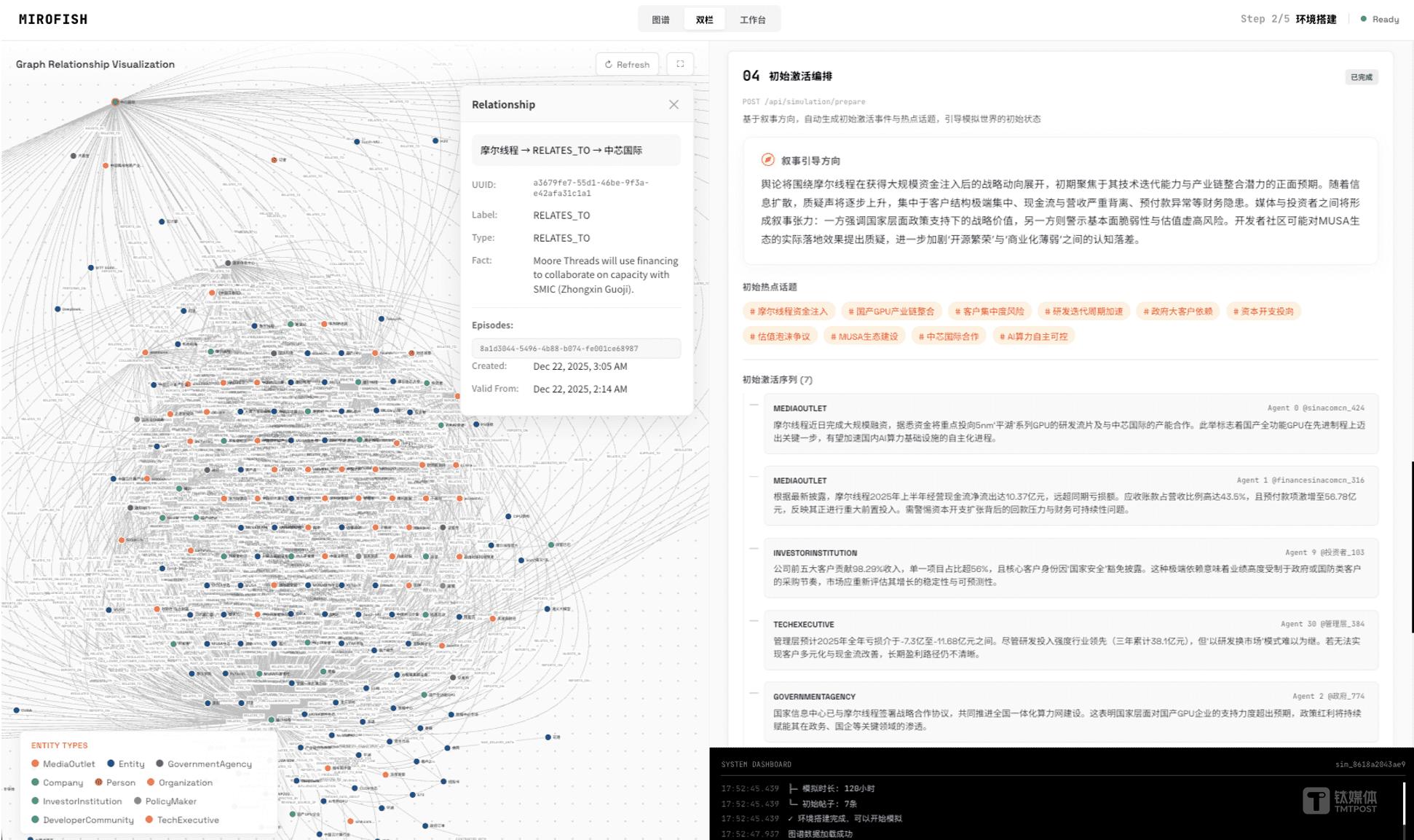
In this process, he conducts in-depth code reviews. “I scrutinize every line of code generated by AI, watching the thought chains and tool invocation chains. If I notice any errors, I immediately intervene and correct them.”
He likens his relationship with AI to that of newlyweds, growing to understand each other better through constant adjustment.
Of course, he also argues with AI. Sometimes after a day of vibe coding, he feels exhausted, with AI making repeated mistakes, leading to frustration—“Is it me? Is my coding ability insufficient? Should I wait another six months?”
He decides to sleep it off. Just as he lies down, his mind involuntarily rethinks the AI coding from earlier. The next morning, he rewrites the “script” and tries again, eventually succeeding.
“In the end, I realized it was my issue,” he laughed.
He admits that his coding skills are “deteriorating”. In the past, he would write code manually, but now he rarely does. “But my code review skills have improved.” He sees this “deterioration” not as a problem but as a trend.
“I don’t think manual coding is necessary. AI coding is expected to improve significantly. The vibe coding era has arrived, so I want to adapt early,” BaiFu stated.
This deep collaborative approach allows him to accomplish what would typically require a team.
Becoming a “super individual” and establishing a “one-person company” is a trendy term capitalists chase, and it seems cool in the AI era, but BaiFu doesn’t want to remain solo.
He is already hiring, interviewing various candidates, from tech experts to fresh graduates. Ultimately, he found himself most drawn to similar “super individuals”—those who are jack-of-all-trades, adept at using AI tools, and can swiftly turn ideas into products.
“I hope our team is a vanguard of AI natives, small and elite,” BaiFu envisions.
Someday, this small team will grow. What does this young man, just starting out, envision for his ideal tech company? “I admire companies like Google, which beautifully blend romanticism and realism,” BaiFu replied.
He isn’t blindly a proponent of vibe coding; he understands that in the future, those proficient in manual coding will become increasingly valuable, especially for high-security projects.
He also knows that commercialization takes time, stating, “We can’t rush to open-source all our code.” He recognizes that security always trumps technology, emphasizing that organizational deployment of OpenClaw must prioritize safety.
These seemingly contradictory traits—romanticism and realism—coexist within BaiFu, perhaps explaining why Chen Tianqiao values him.
In recent years, Chen has invested heavily in brain science research, focusing on the underlying issues of human intelligence. BaiFu embodies a quality that resonates with this concern—an AI-native mindset and approach to work.
“It’s about being clear on why you’re doing it, who you’re doing it for, and how to do it, and then using AI tools to rapidly bring ideas to life,” BaiFu defined being AI native.
This ability to “think clearly and act quickly,” combined with an intrinsic passion for creation, is precisely what Chen is seeking.
8. Still Vibe Coding, Still Raising Fish
This is BaiFu’s story.
His generation of “quasi-programmers” has experienced traditional “problem-solving” education while finding new avenues to unleash creativity in the AI era.
They share the anxiety of synchronizing with the times while being filled with hope for a new world. They are a transitional generation, part of the cohort “moving from the old world to the new”.
BaiFu’s college years coincided with the emergence of AI coding. In his sophomore year, he witnessed the explosion of AI tools, and by his junior year, he was preparing to enter the real world, where created products must meet market demands.
Being at this “interface” between the old and new orders grants them a unique perspective.
BaiFu, an introverted person who dislikes socializing and fears making choices, suddenly became a small star in the global open-source community, receiving multi-million investments from big names and support from large corporations, all before graduating college, while beginning to form his ideal startup team.
He found a way to navigate without excessive socializing. He chose Shengda because Chen Tianqiao offered him a stage where he didn’t have to showcase himself excessively.
Comments
Discussion is powered by Giscus (GitHub Discussions). Add
repo,repoID,category, andcategoryIDunder[params.comments.giscus]inhugo.tomlusing the values from the Giscus setup tool.