OpenClaw has gained popularity in China with its lightweight AI framework, but it faces issues overseas such as data security, compliance risks, and poor adaptation to the domestic ecosystem. Currently, domestic alternatives have formed three main camps: large enterprises’ self-developed solutions, open-source communities, and vertical customizations, covering all scenarios from personal lightweight use to enterprise privatization.
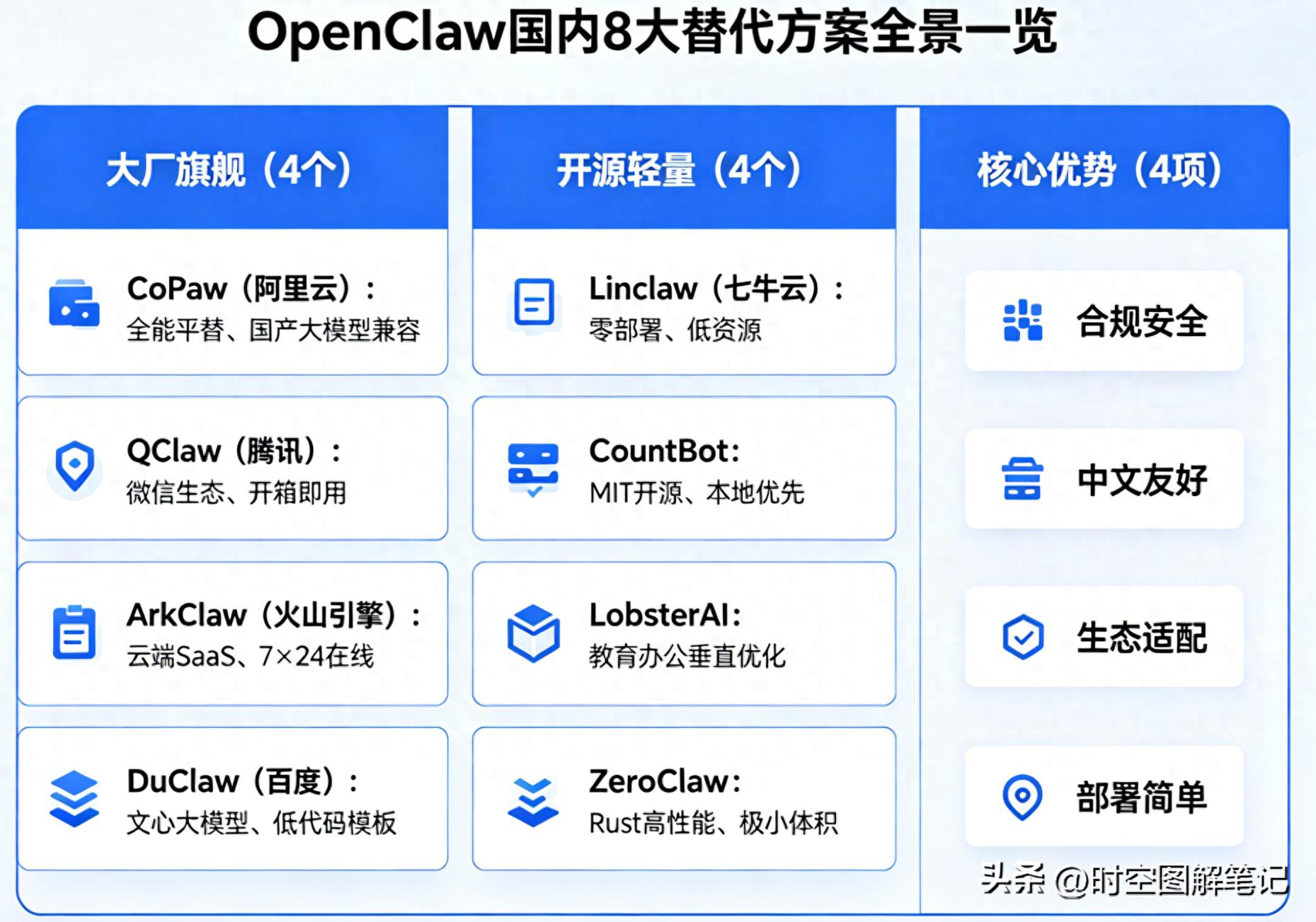
Large Enterprise Flagship Alternatives (Preferred by Enterprises, Safe and Stable)
-
CoPaw (Alibaba Cloud)
The most comprehensive alternative to OpenClaw, featuring a fully self-developed architecture with no overseas dependencies. Its four-layer memory system enables persistent understanding across sessions and is perfectly compatible with domestic tools like DingTalk and Feishu. It supports domestic large models like Tongyi and DeepSeek, with a 30% higher accuracy in understanding Chinese commands compared to OpenClaw. Deployment is extremely simple, requiring just three commands to start, making it ideal for individuals and small to medium enterprises as a compliant solution. -
QClaw (Tencent)
Deeply integrated with the WeChat and QQ ecosystems, this solution is ready to use out of the box with no deployment required, colloquially known as “domestic OpenClaw.” It retains OpenClaw’s core automation capabilities while optimizing for Chinese office scenarios, supporting frequent needs like document processing, schedule management, and data aggregation. Data is stored domestically in compliance with regulations, making it the preferred choice for personal users and teams within the WeChat ecosystem, requiring no technical background to get started. -
ArkClaw (Volcano Engine)
A cloud-based SaaS alternative available 24/7, addressing the local deployment issues of OpenClaw. It is deeply integrated with the Feishu ecosystem, allowing task assignment via @mentions. Leveraging the Doubao large model reduces API costs, ensuring stable execution of complex tasks in Chinese, making it suitable for enterprise collaboration scenarios. The only downside is the lack of privatization support, but its convenience surpasses the original version. -
DuClaw (Baidu)
Based on the Wenxin large model, it focuses on traffic monetization and vertical scenario adaptation, offering both zero-code and low-code modes with rich templates in education, government, and office fields. The intelligent agent application square provides ample resources for newcomers to directly develop, ensuring strong compliance, making it suitable for traditional enterprises undergoing digital transformation.
Open-Source Community Alternatives (Preferred by Developers, Flexible Customization)
-
Linclaw (Qiniu Cloud)
A king of zero-deployment desktop applications, it can be installed with a double-click on Windows and macOS without requiring a Node environment. It covers nine major channels, including WeChat, DingTalk, and Feishu. Resource usage is only 1/5 of OpenClaw, supporting one-click access to local models, making it the optimal choice for personal users and small teams, significantly lowering the technical barrier. -
CountBot
Open-sourced under the MIT license and written in Python for easy auditing, it focuses on lightweight stability and local deployment. It supports switching between local and cloud models with precise understanding of Chinese commands, and the community offers numerous Chinese skill plugins. Its low resource usage makes it suitable for developers seeking control and privacy-sensitive users. -
LobsterAI (NetEase Youdao)
Optimized for educational and office scenarios, this open-source solution is customizable, with Chinese semantic understanding tailored to domestic user habits. It supports multi-platform access, flexible deployment, and balances lightweight functionality, making it ideal for educational institutions and personal learning scenarios, providing a high-quality alternative in vertical fields. -
ZeroClaw
Written in Rust for extreme performance, with a single binary file smaller than 5MB and a startup speed under 10ms, it has very low memory usage. It is suitable for edge devices, servers, and low-power scenarios, outperforming OpenClaw, making it the preferred choice for tech enthusiasts and hardware-constrained environments.
Core Advantages of Domestic Alternatives (Surpassing OpenClaw)
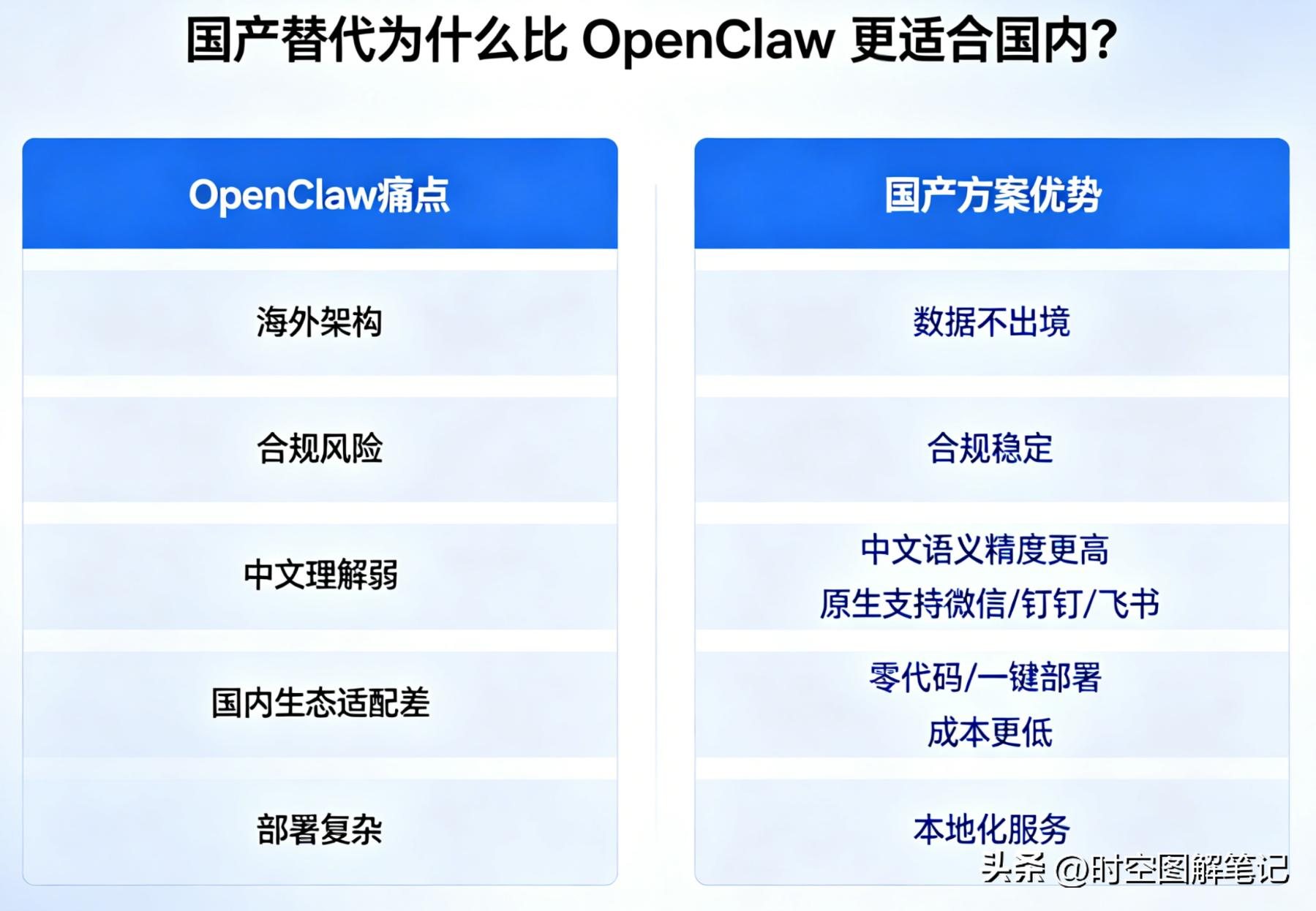
- Compliance and Security: Data is stored domestically and passes regulatory audits, eliminating leakage risks, allowing enterprises to confidently deploy privatized solutions.
- Ecosystem Adaptation: Native support for WeChat, DingTalk, and Feishu aligns with domestic office and lifestyle habits, requiring no additional adaptations.
- Chinese Optimization: Higher semantic understanding accuracy and more precise execution of complex tasks eliminate the shortcomings of overseas frameworks in handling Chinese.
- Easy Deployment: Zero-code and one-click installation lower the usage threshold, allowing ordinary users to operate without technical expertise.
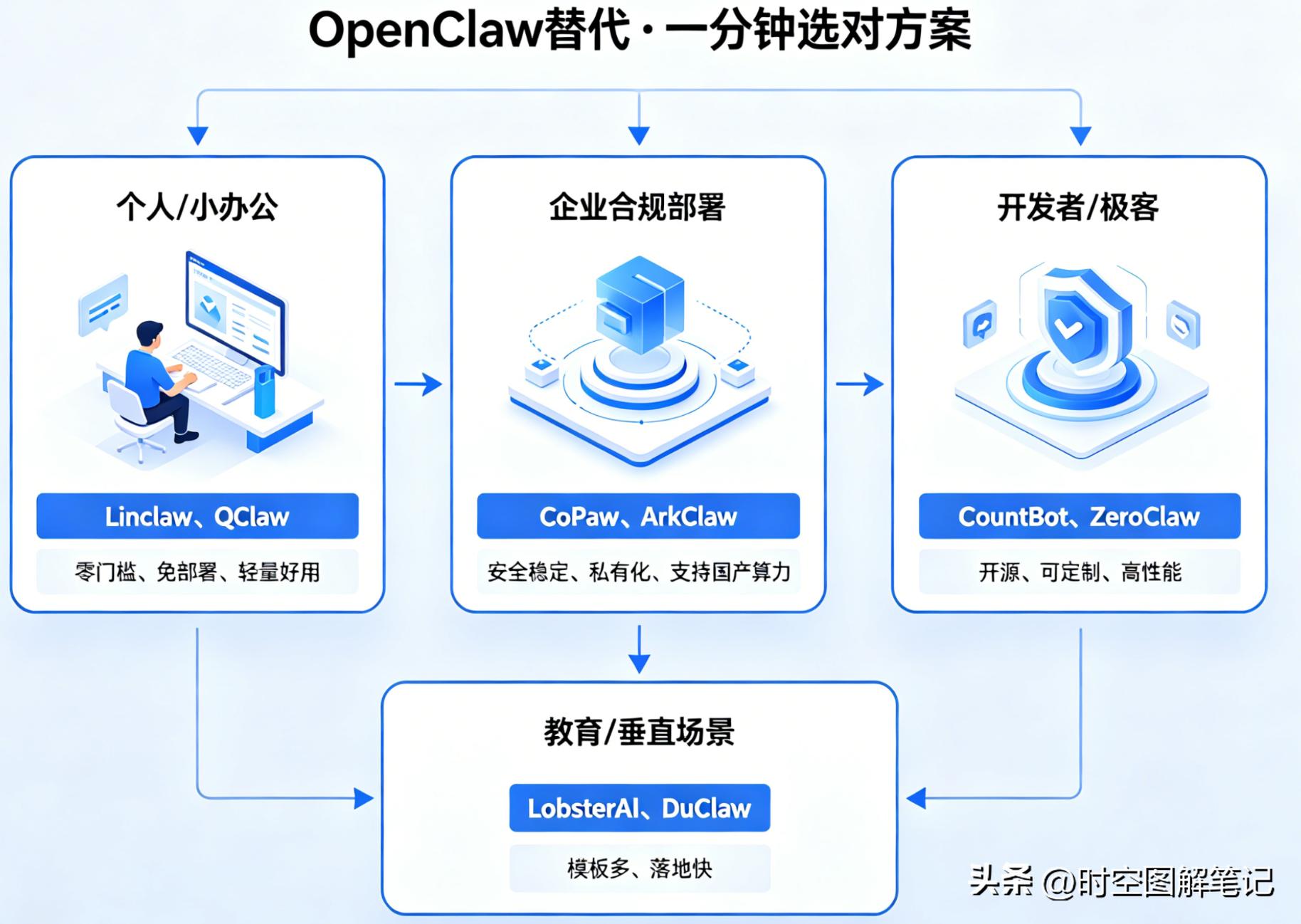
Selection Guide
- Individuals / Small Teams: Prioritize Linclaw and QClaw for zero-barrier, ready-to-use solutions.
- Enterprise Compliance Deployment: Choose CoPaw and ArkClaw for safe and stable adaptation to the domestic ecosystem.
- Developer Customization: Opt for CountBot and ZeroClaw for open-source flexibility and deep modification capabilities.
- Education/Vertical Scenarios: Select LobsterAI and DuClaw for rich templates and quick implementation, accurately meeting the needs of education, government, and office verticals.
The current domestic alternatives to OpenClaw have matured, fully surpassing the original in functionality and ecosystem. Safety, compliance, Chinese friendliness, and low-cost implementation have become core labels. Whether for personal automation or enterprise digital transformation, suitable solutions can be found, completely freeing from reliance on overseas frameworks and achieving autonomous control of AI intelligent agents.
Comments
Discussion is powered by Giscus (GitHub Discussions). Add
repo,repoID,category, andcategoryIDunder[params.comments.giscus]inhugo.tomlusing the values from the Giscus setup tool.